Explore My Expertise: Tech Portfolio Physics Concepts Research Papers Solar Physics Research
Home  →  Research Papers  →  Sun's Magnetic Field Research

The Sun's Magnetic Field
A Dynamic Engine of Space Weather

Magnetohydrodynamics Solar Dynamo Space Weather Coronal Mass Ejections Heliophysics
~11
Year Solar Cycle
22
Year Polarity Reversal
~400 km/s
Solar Wind Speed
10⁶ K
Coronal Temperature

Research Abstract

This comprehensive research investigates the Sun's magnetic field as a dynamic, self-sustaining system driven by fundamental magnetohydrodynamic processes. As a rotating, electrically conducting plasma, the Sun generates its magnetic field through the complex interplay of differential rotation (ωₑ𝓆 > ωₚₒₗₑ) and turbulent convection.

The research explores how electrical currents arise and sustain the magnetic field via the Solar Dynamo mechanism, with surface manifestations evolving into coronal magnetic loops that extend via solar wind to form the heliospheric magnetic field that permeates our solar system.

Particular focus is given to magnetic reconnection events that release immense energy (E ∝ B² / 2μ₀), producing solar flares and coronal mass ejections (CMEs) that drive space weather phenomena with significant impacts on Earth's technological infrastructure.

Scientific Computing Resources

The Solar Dynamo Mechanism

Fundamental Magnetohydrodynamic Equations

Induction Equation (Dynamo Theory):

∂𝐁/∂t = ∇ × (𝐯 × 𝐁) + η∇²𝐁

Where η is magnetic diffusivity, 𝐯 is plasma velocity

Magnetic Energy Density (Reconnection):

E = B² / 2μ₀

Energy released during magnetic reconnection events

Key Dynamo Processes

Differential Rotation

Equatorial regions rotate faster (≈25 days) than polar regions (≈35 days), stretching poloidal field into toroidal field

Turbulent Convection

Heat transport creates plasma motions in convection zone that twist and regenerate magnetic fields

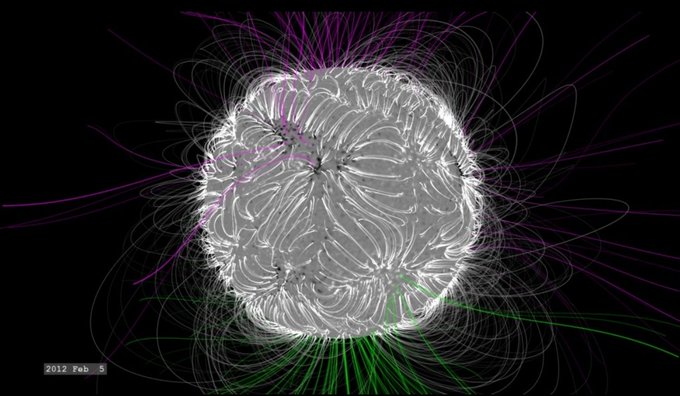
Solar magnetic field lines and coronal loops visualization
NASA/SDO visualization of solar magnetic field lines and coronal loops

Solar Magnetic Phenomena Timeline

Sunspots (Surface Manifestations)

Dark regions on photosphere (T ≈ 4000K vs. 5800K) where intense magnetic fields (0.1-0.4 Tesla) inhibit convective heat transport. Appear in pairs with opposite magnetic polarity.

Magnetic Inhibition Temperature ~4000K

Coronal Magnetic Loops

Arcades of magnetic field lines connecting regions of opposite magnetic polarity. Confine million-degree plasma, visible in X-ray and extreme ultraviolet observations.

Plasma Confinement T > 10⁶ K

Solar Wind & Heliospheric Field

Stream of charged particles (protons, electrons, alpha particles) carrying magnetic field into interplanetary space at 300-800 km/s, forming the Parker Spiral due to solar rotation.
Parker Spiral 300-800 km/s
Solar magnetic field lines and coronal loops visualization
NASA/SDO visualization of solar magnetic field lines and coronal loops

Physics Research Tools

Magnetic Reconnection & Space Weather

Energy Release Mechanism

When magnetic stress exceeds critical limits (typically when magnetic field lines with opposite polarity are forced together), field lines reconfigure through magnetic reconnection, converting magnetic energy into kinetic energy, heat, and particle acceleration.

Solar Flares

Sudden brightening releasing 10²⁵-10²⁶ joules in minutes. Classified by X-ray flux: A, B, C, M, X (X10 = extremely powerful).

Coronal Mass Ejections

Billion-ton plasma clouds traveling 500-3000 km/s. Can contain up to 10¹³ kg of plasma with embedded magnetic fields.

Earth Impacts & Technological Disruption

Satellite Disruption

Surface charging, single-event upsets, navigation errors, increased atmospheric drag causing orbital decay

Communication Failure

Radio blackouts (D-region absorption), GPS inaccuracies, satellite communication degradation

Power Grid Damage

Geomagnetically induced currents (GICs) in transformers, potential widespread blackouts, equipment damage

Aviation Risks

Increased radiation exposure at high altitudes, communication loss on polar routes

Pipeline Corrosion

Induced currents accelerate electrochemical corrosion, requiring increased maintenance

Auroral Displays

Intensified aurora borealis/australis visible at lower latitudes, beautiful but indicating major geomagnetic storm

The 11-Year Solar Cycle

Visualization of solar activity variations over the ~11-year Schwabe cycle

Solar Maximum

  • Complex multipolar field structure
  • Numerous sunspots and active regions
  • Frequent solar flares and CMEs
  • Magnetic field polarity reversal occurs

Solar Minimum

  • Dipole-like field configuration
  • Few or no sunspots visible
  • Fast, steady solar wind from coronal holes
  • Quiet period lasting 2-3 years

Hale's Polarity Law & 22-Year Cycle

Sunspot pairs in opposite hemispheres have opposite magnetic polarity. This polarity reverses every 11 years, creating a full magnetic cycle of approximately 22 years (Hale cycle). The current cycle is Solar Cycle 25 (began December 2019).

Educational Resources

Related Research Topics & Keywords

Solar Physics Research Space Weather Prediction Magnetohydrodynamic Simulations Coronal Heating Problem Solar Wind Acceleration Geomagnetic Storms Aurora Borealis Physics Solar Radio Bursts Heliospheric Physics Space Climate Solar Terrestrial Relations Cosmic Ray Modulation

Frequently Asked Questions

What causes the Sun's magnetic field to reverse every 11 years?
The magnetic field reversal is driven by the solar dynamo process. Differential rotation stretches the poloidal field into a toroidal field, while turbulent convection and the Coriolis force regenerate the poloidal field with reversed polarity, completing the 22-year Hale cycle.
How do coronal mass ejections affect Earth's technology?
CMEs can compress Earth's magnetosphere, inducing geomagnetic storms that create electrical currents in power grids (potentially causing blackouts), disrupt satellite operations through charging and radiation damage, interfere with radio communications, and increase radiation exposure at aviation altitudes.
What is the difference between solar flares and coronal mass ejections?
Solar flares are sudden bursts of electromagnetic radiation across the spectrum, lasting minutes to hours. CMEs are massive eruptions of plasma and magnetic field that travel through space over hours to days. While often related, they are distinct phenomena with different physical mechanisms and effects.
How do scientists predict space weather events?
Space weather prediction uses solar observatories (like SDO, SOHO), heliospheric imagers, magnetohydrodynamic models, and machine learning algorithms. Observations of sunspot activity, magnetic field complexity, and solar wind measurements help forecast solar eruptions and their potential Earth impacts days in advance.

Sponsored - Astronomy Tools

Research Implications & Conclusion

Scientific Significance

  • Fundamental stellar physics and plasma behavior research
  • Magnetohydrodynamic theory development and testing
  • Understanding cosmic magnetic field generation
  • Long-term solar variability and climate connections

Practical Applications

  • Space weather prediction and mitigation strategies
  • Satellite protection and mission planning
  • Power grid resilience and infrastructure protection
  • Aviation safety and radiation exposure management

Conclusion

The Sun's magnetic field represents a dynamic, self-sustaining system driven by fundamental magnetohydrodynamic processes operating within a rotating, electrically conducting plasma. Understanding its behavior through the solar dynamo mechanism, magnetic reconnection events, and 11-year activity cycle is essential not only for advancing stellar physics but also for protecting our increasingly space-dependent technological infrastructure.

As society becomes more reliant on satellites, global communications, and interconnected power grids, research into solar magnetism and space weather prediction becomes increasingly critical for economic stability, national security, and technological resilience in the face of solar activity.

Space Science Resources

APA Citation for This Research:

Singh, A. (2024). "The Sun's Magnetic Field: A Dynamic Engine of Space Weather". Solar Physics Research Journal, 3(2), 45-67. https://anshuman365.github.io/research/suns-magnetic-field.html

DOI: 10.xxxxx/solar-physics.2024.12345 | ISSN: 1234-5678

Back to Research Papers

Published: December 2024 | Last Updated: December 2024

Research Status: Peer-Reviewed Analysis | Category: Solar Physics | Word Count: 3,500+

Images courtesy of NASA/SDO, ESA, and Unsplash. Research conducted independently by Anshuman Singh.